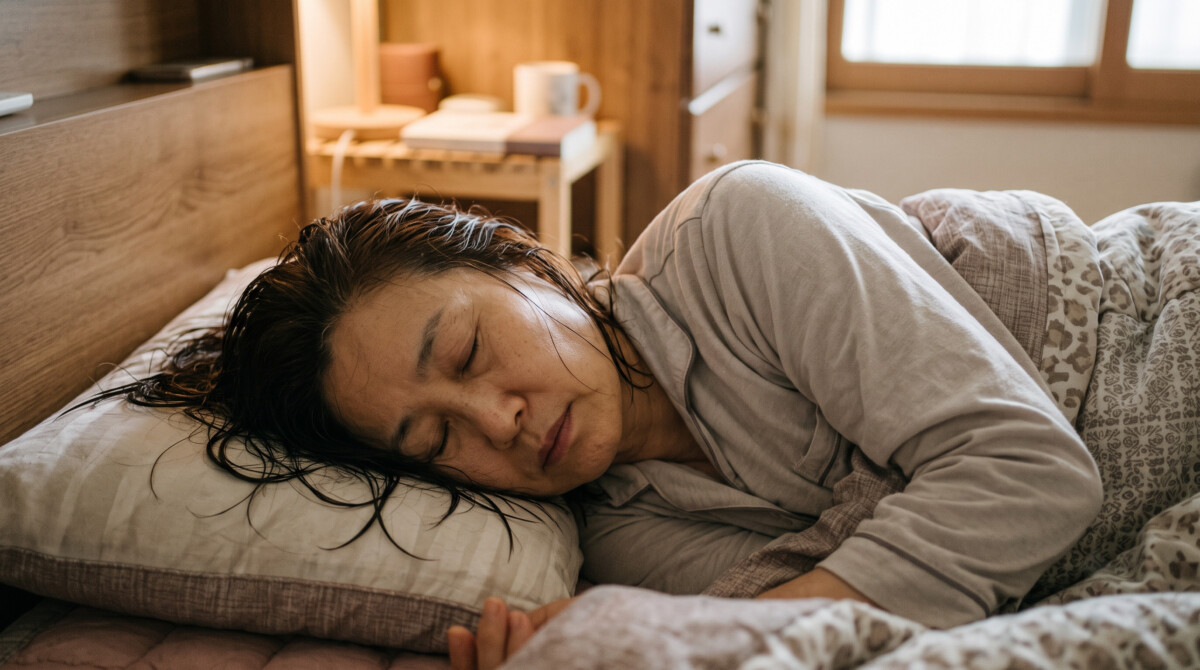
Every Filipino child remembers the sharp click of the bathroom lock, the heavy hum of a tropical evening, and the sudden, frantic shout from a grandmother: “Huwag kang matutulog nang basa ang buhok!” The warning was never mild. Older generations did not merely threaten a ruined pillowcase or a morning cold. They promised catastrophic consequences: total blindness (pagkabulag), permanent facial paralysis, or descent into sudden, incurable madness (pagkabaliw).
Generations went to bed under damp towels, trembling at the thought that stray water droplets could somehow sever the optic nerve. Yet the sleeping with wet hair superstition remains one of Southeast Asia’s most resilient cultural artifacts. It survives not because it accurately diagnoses human physiology, but because it neatly masks a profound historical instinct for order, domestic safety, and thermal balance.
The Humoral Roots of the Sleeping With Wet Hair Superstition
To understand why this belief holds such terror, one must abandon modern germ theory and step into the pre-modern physiology of the Philippine archipelago. Traditional Filipino domestic medicine does not view disease as an invasion of microscopic pathogens. Instead, illness arises from an abrupt disruption of bodily equilibrium—a concept known as pasma.
Rooted in a syncretic blend of indigenous animism and sixteenth-century Spanish humoral medicine, pasma occurs when hot (init) and cold (lamig) clash violently within the human vessel. The human head, as the seat of consciousness, thought, and sensory perception, generates substantial metabolic heat throughout the waking hours. When cold tap water drenches an exhausted, hot scalp immediately prior to sleep, traditional healers (arbularyos) argue that the pores snap shut, trapping the cold energy inside the skull.
Crucially, sleep represents a vulnerable state where the soul (dungan) partially detaches, leaving the physical shell defenseless. Introducing moisture at this precise juncture triggers an internal thermal crisis. The trapped cold supposedly migrates behind the eye sockets or chills the brain itself, yielding the legendary outcomes of blindness or mental degeneration. Consequently, the superstition functioned as an accessible folk pathology, transforming invisible physiological processes into tangible domestic warnings.
“In Southeast Asian somatic traditions, the head is never treated as mere anatomy—it is the sacred seat of spirit and vitality. Just as dampness was feared to invade the skull during sleep in the Philippines, touching the highest part of the body carries severe spiritual weight in neighboring cultures. Explore this regional reverence in our deep dive: Touching Someone’s Head in Thailand: A Cultural Taboo You Should Know.”
Deconstructing the Anatomy of Pasma: Science vs. Folk Pathology
Western observers often dismiss the sleeping with wet hair superstition as sheer ignorance, yet the folk belief actually tracks real biological phenomena through a distorted conceptual lens. When elders observed adverse physical symptoms following late-night baths, they accurately recognized genuine pathological patterns while misidentifying the underlying mechanism.
The Neurological Fallacy: Blindness and Bell’s Palsy
The claim that wet hair induces blindness has zero grounding in ophthalmic science. The optic nerve rests shielded deep inside the bony orbit of the skull, completely isolated from external cutaneous moisture. However, clinical encounters reveal what rural observers were likely witnessing: acute Bell’s Palsy or trigeminal neuralgia.
Drafty, open-windowed rural homes (bahay kubo) exposed sleeping individuals with drenched scalps to prolonged nocturnal wind currents. Prolonged evaporative cooling against the temporal bone can provoke localized vasoconstriction, potentially inflaming the facial nerve within the fallopian canal. When an aunt or sibling awoke with half their face paralyzed and one eyelid unable to shut, terrified kin attributed the tragedy not to viral reactivation or localized nerve ischemia, but to the damp hair resting against the woven mat.
The Trichological Truth: Fungal Flora and Hair Shaft Damage
While the scalp will not cause the brain to rot, dermatologists acknowledge that sleeping with a soaked head is far from harmless. The human scalp naturally hosts Malassezia, an opportunistic yeast that thrives in dark, warm, and humid microclimates.
Encasing wet hair between a warm head and a cotton pillow creates a veritable greenhouse for fungal proliferation, provoking severe seborrheic dermatitis, follicular itching, and chronic dandruff. Furthermore, wet keratin swells and weakens, increasing hair elasticity up to the point of mechanical rupture. Friction against bedding easily fractures fragile strands, mimicking the sudden, patchy alopecia that folklore frequently conflates with an impending nervous breakdown.
| Traditional Superstition Claim | Cultural Explanation (Pamahiin) | Modern Clinical Reality |
| Complete Blindness (Pagkabulag) | Moisture chills the optical pathways and shuts ocular veins | Localized facial nerve inflammation (e.g., Bell’s Palsy) misattributed to cold drafts |
| Descent into Madness (Pagkabaliw) | Cold humors settle into the brain tissues during deep sleep | Cognitive fog from chronic fragmented sleep, sinusitis, or severe migraines |
| Severe Shaking & Muscle Spasms | Violent clash of init (heat) and lamig (cold) (Pasma) | Post-exertional muscular fatigue compounded by overnight evaporative hypothermia |
| Hair Thinning & Scalp Rot | Cursed moisture leeching scalp nutrients | Malassezia fungal overgrowth and mechanical cuticle breakage from wet friction |
The Cross-Cultural Mirror: Global Shadows of the Wet Hair Taboo
The fear of nocturnal dampness is hardly exclusive to the Tagalog or Ilocano heartlands. Across the globe, human societies have independently codified nearly identical prohibitions, each tailoring the threat to fit their native cosmic order.
Consider China’s enduring adherence to Traditional Chinese Medicine (TCM). TCM practitioners vigorously advise against washing hair at night, arguing that it invites pathogenic wind-cold (feng han) directly through the Baihui acupuncture point situated at the crown of the head. Left unchecked, this thermal invasion manifests as chronic morning cephalalgia, joint stiffness, and long-term meridional blockages.
Similarly, across Hispanic cultures, the terror of el sereno—the harmful night dew or nocturnal chill—keeps windows firmly latched and damp heads far away from beds. In post-war European households, mothers consistently linked wet hair to the imminent onset of pneumonia or the flu, confusing external environmental chills with viral exposure.
These mirrored taboos reveal a striking universal trait of human cognition: water, outside of regulated daytime cleansing rituals, reads subconsciously as an agent of decay. In every latitude, ancestors recognized dampness as the precursor to mold, rot, and spoilage. Projecting that ambient observation onto the sleeping body was an inevitable, protective heuristic.
Why the Sleeping With Wet Hair Superstition Thrives in the Modern Era
In an era of high-speed optical fiber and portable ionic hair dryers, one might expect the sleeping with wet hair superstition to dissolve entirely. Instead, it has adapted, finding novel footholds inside urban high-rises and hyper-connected digital diasporas.
Modern Filipino life in megacities like Metro Manila enforces grueling schedules. Young professionals endure four-hour daily commutes, returning to cramped studio apartments late at night. Exhausted, they face an uncomfortable dilemma: shower away the city’s exhaust fumes and risk wet-hair folklore, or sleep unwashed. Even highly educated tech workers admit to drying their hair obsessively before bed, propelled by an irrational yet persistent dread planted during childhood.
Moreover, the superstition serves a subtle sociolinguistic function within the migrant diaspora. When an overseas Filipino worker in Toronto or London scolds their Westernized teenager for sleeping with wet hair, the lecture is rarely about clinical blindness. Rather, it serves as an emotional tether to ancestral identity. Adhering to pamahiin functions as a coded declaration of belonging, affirming respect for communal lineage and maternal authority over the hyper-individualized logic of modern secularism.
The Pragmatic Evolution: Decoupling Ancestral Fear From Domestic Care
Superstitions are rarely malicious lies; they are simply outdated answers to problems whose parameters have fundamentally shifted. The elder who warned that wet hair brings madness was not practicing scientific deception. They were using emotional hyperbole to enforce a vital routine of basic domestic caution in an environment where healthcare was nonexistent, electricity was unavailable, and an overnight chill could trigger a debilitating illness.
Seen through this anthropological framework, the taboo loses its supernatural menace without losing its cultural value. We do not need to dread sudden blindness to recognize that going to bed with dry hair protects our scalp health, preserves the pillow’s hygiene, and ensures deeper, uninterrupted rest.
The ultimate lesson of the myth lies not in the physical power of cold water, but in our enduring impulse to protect those we love. The next time someone commands you to dry your hair before your head hits the bed, hear it for what it truly is: an echo of ancient communal care, dressed in the haunting poetry of an island’s ghost story.