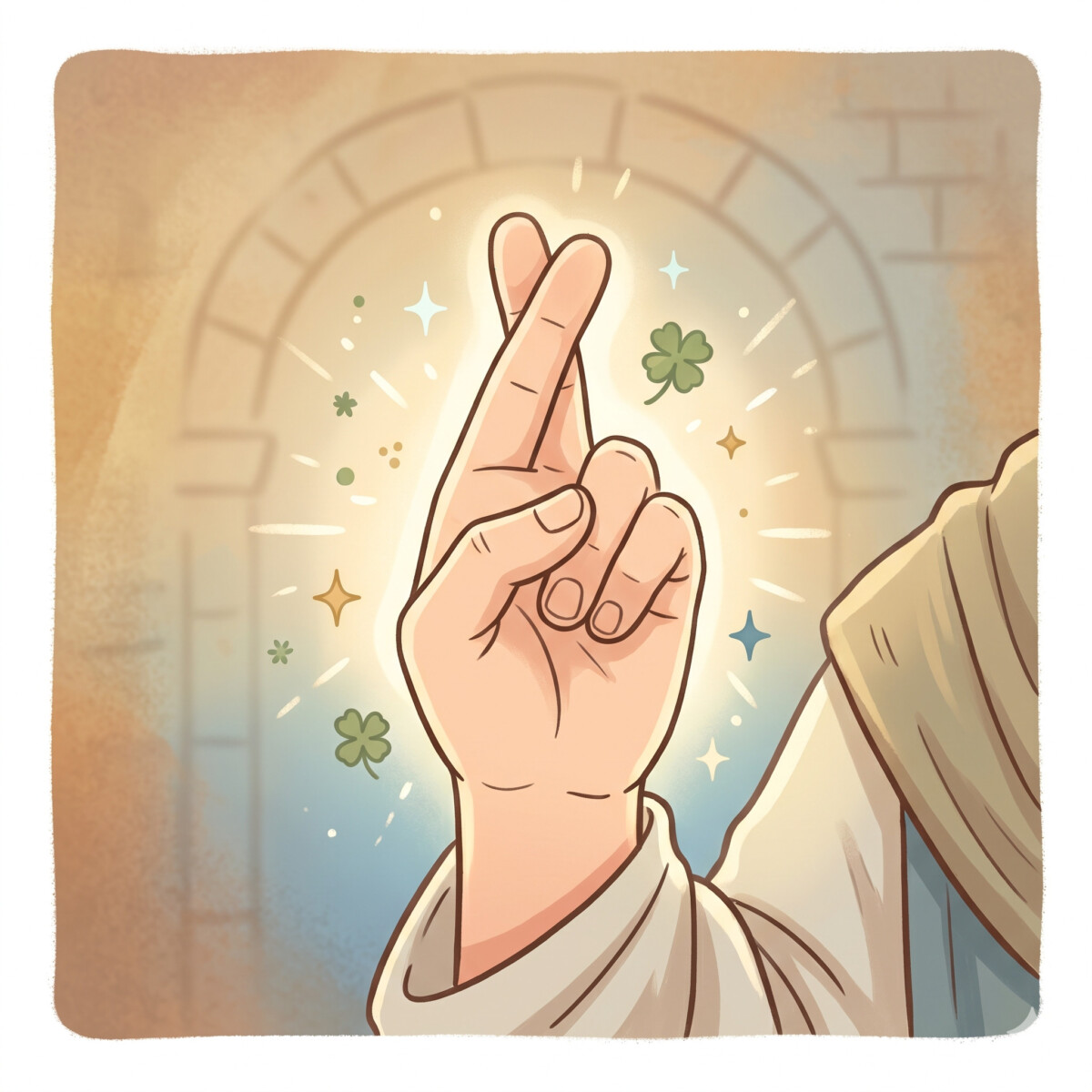
You’re standing in front of a closed door, waiting for the results of a career-defining interview. Or perhaps you’re watching a lottery ball spin in a glass cage. Without thinking, your middle finger slides over your index finger, locking into that familiar, slightly uncomfortable twist. We do it to “wish for luck” or to excuse a “white lie” whispered behind our backs. But have you ever paused to wonder why this specific digital contortion is supposed to alter the fabric of reality?
The crossing fingers origin isn’t just a quirky habit; it is a fossilized remnant of ancient theology, a secret wartime code, and a fascinating window into how the human brain tries to negotiate with the universe. It is the “cross” we carry in our pockets when we are too afraid—or too modern—to pray out loud.
The Early Christian Roots: A Secret Handshake with Fate
To understand the crossing fingers origin, we have to go back to a time when being a Christian was a high-stakes gamble. In the early centuries of the Common Era, under the shadow of the Roman Empire, the cross was not a piece of jewelry; it was a revolutionary symbol.
Historians suggest that the gesture began as a two-person job. When two people shared a wish or wanted to invoke the protection of the Divine, they would each use their index fingers to form a cross. One person’s finger would lay horizontally across the other’s vertical finger. This “X” or “Cross” was believed to be a nexus of power where the spirit world met the physical. By “crossing” their fingers, they were essentially anchoring a prayer into the physical world.
As the years passed and the Church became more institutionalized—and eventually legalized—the gesture evolved for convenience. During the Middle Ages, the ritual shifted from a communal act to a solitary one. If you didn’t have a friend nearby to help you “cross” your fingers, you simply used your own hand. The index and middle fingers became the most efficient way to mimic the crucifix, allowing a person to keep their “prayer” hidden within their palm or behind their back.
The Rational Lens: Why Your Brain Loves a Good Twist
While the crossing fingers origin is steeped in religion, why does it persist in a world governed by logic and smartphones? The answer lies in evolutionary psychology and the concept of agency detection.
The human brain is an incredible pattern-matching machine. We are biologically wired to find “causes” for “effects,” even when none exist. In psychology, this is often linked to operant conditioning. Imagine a prehistoric ancestor who happened to be holding a specific stone when they found a berry bush. Their brain might link the stone to the luck of finding food.
Crossing your fingers works on a similar, albeit more sophisticated, level:
- The Illusion of Control: Life is chaotic. Whether it’s a promotion or a health scare, much of our fate feels out of our hands. Performing a physical gesture—like crossing fingers—provides a psychological “anchor.” It gives the prefrontal cortex a sense of agency, reducing cortisol levels (stress) by making us feel like we’ve “done something” to help the outcome.
- Confirmation Bias: We rarely remember the times we crossed our fingers and failed. But when we cross them and succeed, our brain marks it as a “win” for the ritual. This strengthens the neural pathway, making the gesture feel more powerful over time.
- Proprioceptive Distraction: There is also a minor physiological effect. The slight tension of the fingers provides a tactile sensation that can act as a grounding technique, pulling a person out of an anxiety spiral and back into their body.
Global Variations: One Man’s Luck is Another Man’s Insult
One of the most fascinating aspects of the crossing fingers origin is how it fails to translate across borders. If you travel to Vietnam and cross your fingers to wish someone luck, you might be met with a look of pure horror or a punch in the face. In Vietnamese culture, the gesture is a vulgar representation of female genitalia and is considered a profound insult.
Contrast this with the “thumbs-up” or the “fist.” In many parts of Central and Eastern Europe, such as Germany or Poland, “crossing fingers” isn’t the go-to move for luck. Instead, they “press the thumbs” (Daumen drücken). You tuck your thumbs inside your fists and squeeze. The origin is similar—protecting the thumb (which was seen as a symbol of life/vitality) within the “fortress” of the fingers—but the physical expression is entirely different.
This cultural divergence proves that the power isn’t in the fingers themselves; it’s in the shared narrative we’ve built around them.
The Anthropologist’s Perspective: The Modern Amulet
As an observer of human behavior, I find something deeply moving about the persistence of the crossed finger. We live in an age of data and empirical evidence, yet we still reach for these “micro-rituals.”
I believe the crossing fingers origin tells us that humans are, at our core, storytellers who hate silence. When the universe doesn’t give us an answer, we make one up with our hands. Whether we are lying (crossing fingers behind our back to “cancel out” the sin) or hoping (crossing them in front of us), we are using our bodies to negotiate with morality and destiny.
It’s a witty irony: we use a symbol of the Cross—once the ultimate sign of truth and sacrifice—to justify a lie or to gamble on a football game. It shows our incredible capacity to take the “sacred” and turn it into the “handy.” It is a pocket-sized insurance policy for the soul.
Summary: From Myth to Reality
The journey of the crossing fingers origin takes us from the secret catacombs of Rome to the modern-day boardrooms of New York. It began as a communal prayer, evolved into a personal shield, and survives today as a psychological grounding mechanism.
While it’s unlikely that your overlapping tendons actually influence the cosmic RNG (Random Number Generator) of the universe, the gesture does something arguably more important: it gives you a moment of hope. And in a world this unpredictable, perhaps that’s all the magic we really need.